
Carbohydrates for Race Day: The Complete Guide
A comprehensive, practical guide to glucose, fructose, gut training, running a marathon without hitting the wall, carbohydrate loading, and choosing TE gels for your actual race distance.

A comprehensive, practical guide to glucose, fructose, gut training, running a marathon without hitting the wall, carbohydrate loading, and choosing TE gels for your actual race distance.
Gels, water, electrolytes Carbohydrates work best when dosage, fluid, sodium, and the GI tract are pulled together into a single strategy.
How to read this guide
Start with the basic logic: how many carbohydrates per hour your particular distance actually needs, which transporters are involved in absorption, and why the gut has to be trained in advance. Then move on to choosing a product: the base TE Gel, the dense High CARBS, PH+ for long-haul tolerability, the Electrolyte versions, and Caffeine for the second half of the race.
Why 60 grams of carbohydrate per hour is no longer the ceiling

Why 60 g/h is no longer the ceiling and how to approach 90–120 g/h without chasing a number.
For a long time, fueling for a long race looked simple: one gel per hour, a little water, then just tough it out. For many athletes this is still the standard. But modern endurance has changed a great deal.
Today, strong cyclists, triathletes, marathoners, and trail runners don’t wait to get "hit" by the wall. They eat ahead of time. Not because they’re weak. But because they understand: if the race is long, carbohydrates aren’t a snack. They’re fuel for pace, power, focus, and recovery.
For a long time the upper limit was considered 60 g of carbohydrate per hour. The logic was clear: if you use only glucose or maltodextrin, the body quickly runs into an absorption limit. The German position paper on carbohydrates in sports nutrition notes that the oxidation rate of exogenous glucose during exercise is roughly 1–1.2 g/min and does not increase further simply by ingesting more glucose or maltodextrin; the limitation lies at the level of absorption in the small intestine. (German Journal of Sports Medicine)
Then sports science and practice moved further. It turned out you could use not one absorption pathway but several. Glucose and maltodextrin provide one stream. Fructose taps into another. That’s why carbohydrate blends allow an athlete to get more energy during exercise. Reviews of multiple transportable carbohydrates show that combinations of carbohydrates using different transporters can increase exogenous carbohydrate oxidation and be beneficial in long competitions. (PubMed)
Today, 60 g/h is no longer the upper limit. It’s more of a baseline for those just starting to build their fueling. For long races, 90 g/h has become a normal working zone. For well-trained athletes, 100–120 g/h no longer looks like anything extreme. And at the elite level you see strategies of 150–180 g/h and higher — especially in triathlon and cycling.
In professional triathlon this is already visible in real examples. Triathlete broke down the fueling of top athletes at the 2025 Ironman World Championship: Kristian Blummenfelt took in about 177 g of carbohydrate per hour on the bike and about 130 g/h on the run; Kasper Stornes — about 175–180 g/h on the bike and 100–120 g/h on the run. That same article specifically emphasizes: this isn’t chaos, it’s months of gut training, testing, and individual tuning. (Triathlete)
Why carbohydrates matter so much
In running, cycling, triathlon, and trail, the body uses both fat and carbohydrates. But it’s not a switch: you can’t simply "turn off carbohydrates" and "turn on fat." At high intensity the contribution of carbohydrates grows. Fat remains an important fuel, but it can’t cover energy demand fast enough when you need to run marathon pace, work uphill, hold power on the bike, or attack in a race.
Asker Jeukendrup, at MySportScience, specifically addresses this myth: as intensity rises, fat and carbohydrates don’t "switch" abruptly but shift their relative contributions; at high intensity, reliance on carbohydrates increases. (askerjeukendrup)
So in a long race the question isn’t whether carbohydrates are needed. The question is different: how many carbohydrates per hour you can absorb without stomach problems, and how consistently you can repeat that in training.
If carbohydrates are scarce, usually power drops first. Then pace. Then focus. Then the mistakes begin: ate too late, drank too late, started chasing your fueling, overloaded the stomach, got nauseous. In the end the problem isn’t one gel. The problem is the absence of a plan.
What 90–120 g/h changed
There are now studies where well-trained trail runners were compared at 60, 90, and 120 g of carbohydrate per hour during a mountain marathon. In the study by Viribay and colleagues, high carbohydrate intake — 120 g/h — was associated with a smaller rise in markers of muscle damage and lower internal load compared with 60 and 90 g/h. (PubMed)
In another study on a similar topic, 120 g/h during a mountain marathon could limit neuromuscular fatigue and improve recovery of high-intensity running capacity 24 hours later. (PMC)
This is an important point. 120 g/h isn’t a magic number. It’s not something you should just grab and repeat at your very first race. But it shows that the old ceiling has moved. The body is capable of taking in more carbohydrates if you choose the right sources and train your fueling in advance.
What this means for the average athlete
You don’t need to start at 120 g/h. You need to start with an honest answer: how much are you really eating right now?
Many athletes think they fuel adequately, but in practice it comes out to 25–40 g/h. In a marathon that’s one gel every 40–50 minutes. On trail — "ate something at the aid station." On the bike — "a bar now and then." For an easy workout that may be enough. For a race where you need to hold pace for several hours, often it isn’t.
A working progression:
| Current level | Next step |
|---|---|
| 20–30 g/h | learn to eat 40–50 g/h |
| 40–50 g/h | move up to 60 g/h |
| 60 g/h | test 70–80 g/h |
| 80 g/h | move up to 90 g/h |
| 90 g/h | try 100–120 g/h if well tolerated |
The main mistake is jumping straight from 40 to 100 g/h. The stomach isn’t ready for it. Fueling has to be trained just like pace, climbs, and the finishing kick.
How to apply this in practice
For most athletes a good working zone is 60–90 g of carbohydrate per hour. That alone significantly changes the quality of long workouts and races. For well-trained athletes — 90–120 g/h. Higher — only after regular testing.
Within the Training Endurance line this can be assembled in different ways:
TE 1:0.8 — 36 g of carbohydrate, the base gel for regular fueling.
TE 2:1 — 40 g of carbohydrate, the classic scheme for 60–90 g/h.
TE High CARBS — 50 g of carbohydrate, when you need more energy in a single stick.
TE PH+ — 36 g of carbohydrate and a gentler pH logic for a long race.
TE Electrolyte — 36 g of carbohydrate plus electrolytes for heat, mountains, and heavy sweating.
TE Caffeine — 36 g of carbohydrate and 100 mg of caffeine for key segments.
A simple example scheme:
2 TE 1:0.8 gels per hour = 72 g of carbohydrate per hour.
2 TE 2:1 gels per hour = 80 g of carbohydrate per hour.
2 TE High CARBS gels per hour = 100 g of carbohydrate per hour.
This is no longer "ate a gel when I started to feel bad." This is a plan.
Conclusion
60 g/h is no longer the ceiling. It’s the starting point for anyone who wants to fuel deliberately. Modern endurance has moved on to 90, 100, 120 g/h and higher, but the path there runs not through heroics, but through gut training, the right carbohydrates, water, sodium, and a repeatable plan.
You don’t need to eat more for the sake of a number. You need to eat more precisely for your race.
TE High CARBS Test this logic in the TE selector: gels, water, sodium, and tolerance are calculated as one plan.
Glucose, fructose, and transporters: why a gel is about more than just grams

Grams matter, but the carbohydrate source and the transporters in the gut determine how much energy actually reaches the work.
A sports gel’s packaging almost always states how many carbohydrates it contains: 25 g, 30 g, 36 g, 40 g, 50 g.
But for a race, grams aren’t all that matter. What matters is which carbohydrates they are and through which pathways they’ll be absorbed.
You can eat 90 g of carbohydrate per hour and get energy. Or you can eat the same 90 g and get bloating, nausea, and a desire never to open a gel again. The difference often isn’t willpower, but composition, water, and how well the stomach is prepared.
One pathway quickly hits its limit
Glucose and galactose are absorbed in the small intestine via the SGLT1 transporter. This is a sodium-dependent mechanism. It’s important, but its capacity isn’t infinite.
If you use only glucose or only maltodextrin, the body runs into the limit of this pathway faster. Maltodextrin is convenient in this sense: it’s less sweet and lets you deliver more carbohydrate in a smaller volume, but after being broken down it still goes mainly through the glucose pathway.
That’s why the old recommendations held around 60 g/h for a long time: going higher became difficult not because the athlete "can’t handle it," but because a single absorption pathway was overloaded.
Fructose opens a second pathway
Fructose uses a different transporter — GLUT5. This is the key to modern high-carb fueling.
When a gel contains not only maltodextrin/glucose but also fructose, the body doesn’t try to push the whole stream through one entrance. It uses different transporters. Glucose and maltodextrin go predominantly through SGLT1. Fructose — through GLUT5. GLUT2 participates in the onward transport of sugars across the intestinal cells. A modern review of intestinal transporters describes exactly this scheme: SGLT1 and GLUT2 are associated with the absorption of glucose and galactose, and GLUT5 — with the absorption of fructose. (PMC)
The practical takeaway is simple: if you want to go above 60 g/h, it’s better to use a carbohydrate blend rather than a single source.
That’s exactly why the 2:1, 1:0.8, and 1:1 formulas appeared.
What 2:1 means
The 2:1 formula usually means two parts maltodextrin/glucose and one part fructose.
This is the classic scheme. It fits the 60–90 g/h range well. So for many athletes who want to move from "a gel now and then" to a proper race strategy, 2:1 is an easy starting formula.
MySportScience explains that at intakes around 90 g/h, 2:1 is often used, because roughly 60 g falls to the glucose component and about 30 g to fructose. But this isn’t a magic ratio — it’s a practical scheme for a specific dosage. (askerjeukendrup)
At Training Endurance there’s TE 2:1 for this: 40 g of carbohydrate per stick. It’s convenient to slot into a plan for a marathon, a long trail, cycling, or triathlon.
Example: 1 TE 2:1 gel every 30 minutes = 80 g of carbohydrate per hour.
For many athletes that’s already a strong step forward.
What 1:0.8 means
The 1:0.8 formula has become popular in modern high-carb logic. It provides a greater fructose contribution compared with the classic 2:1 and fits tasks around 90–110 g/h better.
Asker Jeukendrup writes that there is no universal "ideal" ratio: it depends on the total carbohydrate dose. At 90 g/h, 2:1 can be a good option, while closer to 110 g/h the 1:0.8 ratio looks more logical. (askerjeukendrup)
At Training Endurance the 1:0.8 formula is used in several gels:
TE 1:0.8 — 36 g of carbohydrate, the base gel.
TE High CARBS — 50 g of carbohydrate for high energy delivery.
TE PH+ 1:0.8 — 36 g of carbohydrate plus a gentler pH logic.
TE Electrolyte — 36 g of carbohydrate plus electrolytes.
TE Caffeine — 36 g of carbohydrate plus 100 mg of caffeine.
What 1:1 means
The 1:1 formula provides equal amounts of the maltodextrin/glucose component and fructose. This can be useful when an athlete tolerates fructose well and wants to build a higher carbohydrate strategy.
But here individuality is especially important. One athlete eats 1:1 perfectly. Another quickly gets discomfort. So 1:1 isn’t "better," it’s "different." It has to be tested.
At Training Endurance this need is covered by TE PH+ 1:1 — a gel with buffering logic and a calmer profile for long-haul work.
Why sodium matters too
SGLT1 is a sodium-dependent transporter. That doesn’t mean you need to bury every gel in salt. But it explains why carbohydrates, water, and electrolytes can’t be completely separated from one another.
In a long race the system looks like this:
carbohydrates provide energy;
water helps carry the solution further along;
sodium helps maintain water-salt balance and participates in transport mechanisms;
a trained GI tract lets you absorb all of this at intensity.
If an athlete eats gels but drinks little, the gel can linger in the stomach. If they drink a lot of water but lose a lot of sodium, hydration can fall apart. If they eat a lot of carbohydrates but haven’t trained the GI tract, the numbers on the packaging won’t help.
How to choose a formula
| Goal | What to choose |
|---|---|
| 40–70 g/h | TE 1:0.8 or TE 2:1 |
| 70–90 g/h | TE 2:1, TE 1:0.8, alternating gels |
| 90–110 g/h | TE 1:0.8, TE High CARBS, PH+ 1:0.8 |
| 100–120 g/h | High CARBS, 1:0.8, a combination of gels and drink |
| Long heat / trail | TE Electrolyte, PH+, electrolyte capsules |
| Second half of the race | PH+, Caffeine, neutral flavors |
Conclusion
Grams matter. But grams without an understanding of composition are only half the picture.
If you want to consistently eat more than 60 g/h, you need to look not only at the amount of carbohydrate but also at the sources: maltodextrin, glucose, fructose, the ratio, water, sodium, and tolerance.
A modern gel isn’t just sugar. It’s a way to deliver energy through different transport pathways.
TE 1:0.8 / 2:1 Within the TE line you can separate energy and electrolytes: choose the gel’s carbohydrate profile and add Regular or PH+ depending on conditions.
How to train your gut for 90–120 grams of carbohydrate per hour

The gut is trained just as systematically as pace: it’s better to raise carbohydrates gradually and in training.
Most fueling problems in a race don’t start during the race.
They start several weeks before the start, when an athlete trains without fueling, and then at the competition suddenly decides to eat 80, 90, or 100 g of carbohydrate per hour.
The stomach isn’t ready for it. The gut isn’t ready for it. Intensity is high. The nervous system is under stress. Heat, descents, climbs, heart rate, caffeine, water. And in that moment the athlete is surprised that the gel didn’t go down well.
Fueling has to be trained.
The GI tract is part of fitness
In endurance sport we’re used to training the legs, the heart, breathing, technique, climbs, descents, power. But the GI tract is often left for later. That’s a mistake.
The gastrointestinal tract is responsible for delivering water and carbohydrates into the blood during prolonged exercise. If it can’t keep up, energy doesn’t reach the muscles.
The scientific literature uses the term gut training. Jeukendrup’s review notes that nutritional training can improve gastric emptying and absorption, and reduce the likelihood or severity of gastrointestinal problems during competition. (PubMed)
Put simply: if you want to eat a lot in a race, you have to eat in training.
The GI tract adapts to what you do regularly
Fueling training isn’t a metaphor. A recent 2023 systematic review on gut training and the feeding challenge shows that such protocols can reduce gastrointestinal discomfort and potentially improve carbohydrate tolerance during exercise. (PMC)
This matters for athletes who want to reach 90–120 g/h. If in training you eat 30–40 g/h, and in a race you suddenly try to eat 90–100 g/h, that’s not a strategy. It’s an experiment at the start line. The stomach isn’t obligated to handle a task it has never performed.
Why you can’t start straight at 120 g/h
120 g/h isn’t a starting dose. It’s a level you arrive at gradually.
In the study on elite trail runners, the athletes didn’t simply show up to a mountain marathon and start eating 120 g/h. They trained in advance to use the target amount of carbohydrate. That’s exactly why the high doses were tolerable. In that study, 120 g/h was compared with 90 and 60 g/h; the 120 g/h group showed lower internal load and better recovery markers 24 hours later. (PMC)
The key idea:
first tolerance, then numbers.
How to gauge your current level
Before building a plan, you need to honestly assess how many carbohydrates you can already eat without problems.
Answer 5 questions:
-
How many gels do you actually eat on a long workout?
-
How many minutes after the start does your first intake begin?
-
How much water do you drink with a gel?
-
Do you get bloating, nausea, burping, diarrhea?
-
Can you repeat your fueling at pace, not just on an easy workout?
If you’re currently eating 30–40 g/h, don’t jump straight to 100 g/h. It’s better to go through stages.
A 6–8 week progression
Below is an example. It can be adapted to your sport, pace, heat, and goal.
| Week | Target on the key long session |
|---|---|
| 1 | 40–50 g/h |
| 2 | 50–60 g/h |
| 3 | 60–70 g/h |
| 4 | 70–80 g/h |
| 5 | 80–90 g/h |
| 6 | 90–100 g/h |
| 7 | 100–110 g/h, if everything is calm |
| 8 | 110–120 g/h, only if there are no problems |
If at some stage persistent GI problems appear, don’t push further. You need to roll back and check water, concentration, gel type, fructose, caffeine, and intensity.
Where to start
If you’re just beginning systematic fueling, a simple scheme:
TE 1:0.8 every 35–40 minutes
This gives roughly 54–62 g of carbohydrate per hour.
Next:
TE 1:0.8 every 30 minutes
That’s already 72 g/h.
The next step:
TE 2:1 every 30 minutes
That’s 80 g/h.
Then:
TE 1:0.8 every 20 minutes
That’s 108 g/h.
And for well-trained athletes:
2 × TE High CARBS per hour
That’s 100 g/h.
Which workouts to train fueling on
Fueling needs to be tested:
- on the long run;
- on the tempo long run;
- on a workout in the heat;
- on climbs;
- on the bike in the aero position;
- on the run off the bike;
- on descents in trail;
- on race-like workouts.
Eating a gel on an easy run is one thing. Eating a gel at marathon pace is another. Eating a gel in the 4th hour of a trail is a third.
Why water is mandatory
A gel is a concentrated product. The more carbohydrate in the stick, the more important water is.
If you eat a dense gel without water, it can linger longer in the stomach. That doesn’t mean the gel is bad. It means the system is incomplete.
The rule is simple:
gel + water = a working scheme.
gel without water = a risk of overloading the GI tract.
This is especially important for high-carb formats, where a single stick holds 40–50 g of carbohydrate.
Where electrolytes fit in
In a long race the problem often isn’t only carbohydrates. If it’s hot, if there’s a lot of sweat, if white salt streaks stay on your clothing, if you drink a lot of water but feel weak — you need to count not only carbohydrates but sodium too. In Training Endurance Regular electrolyte capsules, one capsule contains 149.5 mg of sodium, 48 mg of potassium, and 14 mg of magnesium; PH+ contains 155.2 mg of sodium, 52 mg of potassium, 19.5 mg of calcium, and 7 mg of magnesium.
What to record after a workout
After each test workout, record:
- how many carbohydrates per hour;
- how much water per hour;
- how much sodium per hour;
- which gels;
- what intensity;
- what temperature;
- whether there were GI symptoms;
- how you felt in the last 30 minutes;
- how you recovered the next day.
After 4–6 workouts you can usually see where the mistake is. Sometimes the dosage doesn’t suit the athlete. Sometimes there isn’t enough water. Sometimes there’s too much caffeine. Sometimes the flavor is too acidic. Sometimes the problem is that they start eating too late.
Conclusion
The GI tract can be trained. But it can’t be fooled.
If you want to eat 90 g/h in a marathon, train 90 g/h in advance. If you want 100–120 g/h on the bike or in an ultra, make it part of your preparation.
Fueling isn’t what saves you when things are already bad. Fueling is what keeps the crisis from starting.
TE PH+ / High CARBS Use this article as a checklist for training: test the flavor, water, carbohydrate dose, and GI response before the start.
Why strong cyclists and marathoners eat in training

Strong athletes eat in training not out of weakness, but to train the quality of their work and their race fueling.
There’s an old belief: "in training you have to tough it out," "gels only for the race," "if you eat, you’re not developing fat metabolism."
In reality, strong athletes eat in training constantly. Not on every easy run. Not always the same way. But on key sessions, long workouts, tempos, camps, and race simulations, fueling is part of the plan.
Not because the athlete can’t tough it out. But because they want to complete the workout with quality.
A workout isn’t a hunger strike
If you’re doing an easy 40–50 minute jog, gels often aren’t needed. But if it’s a long session, a tempo workout, a 4–5 hour ride, a trail with elevation gain, a marathon-specific session, or a brick in triathlon — carbohydrates help preserve quality.
When carbohydrates are scarce, the body can complete the workout, but the price will be higher. The last intervals are worse. Technique falls apart. Heart rate climbs. Recovery takes longer. The next day, the quality of the following session is worse.
Modern endurance fueling logic doesn’t come down to always eating the maximum. It comes down to matching fueling to the task of the day. An easy short run can be done without gels. But a long, tempo, or marathon-specific session, a 3–5 hour ride, or a workout in the heat requires a different strategy.
The position paper of the German Society for Nutrition notes that prolonged exercise in the range of roughly 70–75% VO₂max for more than 75–90 minutes requires a high carbohydrate contribution, and glycogen stores in the muscles and liver are limited. (German Journal of Sports Medicine)
Why cyclists eat a lot
Cycling came to high-carb fueling faster than other sports. On the bike it’s easier to drink, easier to eat, there’s less impact stress on the stomach, the duration of work is longer, and energy expenditure is enormous.
Among professional cyclists and triathletes today, 90–120 g of carbohydrate per hour is often seen, and in some cases higher. At the 2025 Ironman World Championship, protocols of 120+ g/h were described in several professional athletes, including Blummenfelt, Stornes, Løvseth, and others. (Triathlete)
This is exactly the modern approach: harder training — more precise fueling.
Not "always eat the same." Not "never eat." But give the body fuel for the task.
Why marathoners also eat more
In running it’s harder: the stomach gets jostled, drinking is awkward, pace is high, aid stations are limited. But that’s exactly why fueling needs to be trained even more carefully.
A recent example from the elite — Sabastian Sawe. According to Maurten, in Berlin 2025 his target was about 105 g/h, and in London — 115 g/h, roughly 230 g of carbohydrate over the marathon. This was accompanied by a personal gut-training plan and rehearsing race fueling in training. (Maurten)
This doesn’t mean every amateur needs to eat 115 g/h. It means that even for top marathoners, fueling has become as much a part of the result as shoes, volume, pace, and running economy.
What fueling in training provides
- Quality of work
If the task is marathon pace, intervals, a long climb, or power on the bike, carbohydrates help preserve intensity to the end.
- Gut training
The gut adapts to what you do regularly. If in training you eat little, and in a race you try to eat a lot, the risk of problems is higher. The Training the Gut review states directly that the GI tract can be adapted to competition conditions, and nutritional training can improve tolerance. (PubMed)
- Recovery
In hard workouts, carbohydrates during work can reduce the depth of the energy hole. This is especially important at camps, with two workouts a day, in multi-day blocks, and before the next key session.
- Confidence
In a race the athlete should open a gel without hesitation. They should know: this flavor works, this dosage works, this amount of water suits me, this capsule doesn’t irritate the stomach.
A race isn’t the place for experiments.
Do you need to eat on every workout
No.
On easy short workouts you can often go without a gel. Especially if the goal is recovery or calm aerobic volume.
But there are workouts where fueling is needed almost always:
- a long run over 90 minutes;
- a tempo long run;
- marathon-specific work;
- a trail with elevation gain;
- a 2.5–5 hour ride;
- a brick in triathlon;
- a workout in the heat;
- a second workout of the day;
- a race simulation;
- the last big workout before the start.
How to build gels into a workout
A simple option for running:
up to 90 minutes: you can go without a gel, or 1 gel if the workout is intense.
90–150 minutes: 40–70 g/h.
2.5 hours and longer: 60–90 g/h.
for well-trained athletes: 90–110 g/h on specific sessions.
A simple option for cycling:
1–2 hours: 30–60 g/h, if there’s intensity.
2–4 hours: 60–90 g/h.
4+ hours: 80–100 g/h.
well-trained: 100–120 g/h and higher only after testing.
Which products to use
For base workouts, TE 1:0.8 and TE 2:1 will do.
For long intense workouts where you need a lot of energy in fewer packages, TE High CARBS makes sense.
For heat, mountains, and heavy sweating — TE Electrolyte or a pairing of regular gels with electrolyte capsules.
For the second half of hard work — TE PH+, if you want a gentler profile, and TE Caffeine, if you need caffeine for focus.
Conclusion
Strong athletes eat in training not because they can’t tough it out. They eat because they train the race system.
Gels in training aren’t a crutch. They’re a tool.
They help you complete the work, prepare the GI tract, test the strategy, and arrive at the start without surprises.
TE base gels Test this logic in the TE selector: gels, water, sodium, and tolerance are calculated as one plan.
A marathon without the wall: how many gels you need for 42.2 km

How many gels to take for 42.2 km and how to avoid the wall without a random sugar panic at kilometer 30.
The "wall" in a marathon rarely comes on suddenly. Usually it’s prepared in advance.
First the athlete eats little. Then waits until it gets hard. Then tries to catch up on fueling. The stomach already works poorly. Pace drops. Heart rate doesn’t help. Legs are empty. The head can’t count the kilometers.
The problem isn’t one missed gel. The problem is the strategy.
Why a marathon requires fueling
Even if you loaded well on carbohydrates before the start, your glycogen store is limited. The higher the pace, the greater the importance of carbohydrates. Fat works too, but at marathon intensity carbohydrates remain the key fuel.
Modern recommendations for carbohydrate during exercise usually depend on duration: 30–60 g/h for events of moderate duration and 60–90 g/h for longer races; using multiple transportable carbohydrates, well-trained athletes can go higher. (PMC)
The main principle
Don’t wait for hunger.
In a marathon you eat not because you feel like it. You eat to hold your pace through 25, 30, 35, and 40 km.
A working rule:
the first intake — in the first 20–30 minutes;
after that — regularly;
don’t chase fueling at the end;
wash down every gel with water.
How many carbohydrates per hour you need
It depends on level, speed, experience, and tolerance.
| Level | Working guideline |
|---|---|
| First marathon / sensitive GI tract | 40–60 g/h |
| Well-trained amateur | 60–80 g/h |
| Experienced athlete | 80–90 g/h |
| Strong, well-trained runner | 90–110 g/h |
| Elite / special protocols | 100–120 g/h and higher |
Don’t copy the elite. Choose a level you can repeat in training.
A recent example from a top marathon shows where the elite is headed: Sabastian Sawe, according to Maurten, had a target of about 115 g/h in London after a training protocol and GI preparation. (Maurten)
But for most athletes, even the shift from 30–40 g/h to 60–80 g/h makes an enormous difference.
How many gels you need for a marathon
Let’s calculate simply.
If you run a marathon in 3 hours and want to get 70–80 g/h, you need roughly 210–240 g of carbohydrate for the whole distance.
If one gel contains 36 g of carbohydrate: 6 gels = 216 g of carbohydrate.
If one gel contains 40 g of carbohydrate: 6 gels = 240 g of carbohydrate.
If one gel contains 50 g of carbohydrate: 5 gels = 250 g of carbohydrate.
But what matters isn’t just the number of gels, it’s the distribution.
An example scheme for 3 hours
Option 1: a gentle scheme
- 0:25 — TE 1:0.8
- 0:55 — TE 1:0.8
- 1:25 — TE 1:0.8
- 1:55 — TE PH+
- 2:25 — TE Caffeine
- 2:45 — as you feel, if needed
That’s roughly 72 g/h with regular intake.
Option 2: the classic scheme
- 1 TE 2:1 gel every 30 minutes
That’s 80 g/h.
Option 3: for well-trained athletes
- TE 1:0.8 every 20–25 minutes
- one of the gels in the second half — TE Caffeine
- some of the gels can be swapped for PH+ for a gentler flavor experience
That’s already 86–108 g/h, and this scheme absolutely must be trained.
When to place caffeine
Caffeine shouldn’t be used in every gel back to back. It works better when there’s a reason.
For a marathon, logical points:
- before the second half;
- after 25–28 km;
- before a hard segment;
- closer to 32–35 km, if caffeine is well tolerated.
TE Caffeine contains 36 g of carbohydrate and 100 mg of caffeine. For many athletes that’s already a noticeable dose, so it needs to be tested in advance.
Why you need water
A gel without water is a common mistake.
If you open a dense gel at high intensity and don’t wash it down, it can pass through the stomach with more difficulty. Especially if there are many gels, the pace is high, it’s hot, or you’re already tired.
A simple scheme: gel at the aid station → water right away → keep running.
You don’t need to wash it down with a liter. But a few normal gulps are needed.
What to do if it’s hot
In the heat, a carbohydrate strategy alone isn’t enough. You need to count fluid and sodium.
Options:
- use TE Electrolyte on some of the intakes;
- add electrolyte capsules;
- alternate regular gels and PH+;
- don’t drink too much plain water;
- test in advance how much fluid you can actually drink at pace.
For a marathon in the heat, a simple logic works well:
carbohydrates — from gels;
water — from the aid stations;
sodium — from an Electrolyte gel or capsules;
caffeine — targeted in the second half.
Typical mistakes
Mistake 1. The first gel too late
If your first gel is at 18–20 km, you’re already late.
Mistake 2. One gel per hour
For many marathoners this is too little. One gel usually provides 25–40 g of carbohydrate. In a marathon that’s often not enough.
Mistake 3. All gels with caffeine
Caffeine can help, but it can also overload the nervous system and the stomach. Better to use it in a targeted way.
Mistake 4. Not training fueling at marathon pace
On an easy run a gel can go down perfectly. At marathon pace — differently. It needs to be tested in specific workouts.
Mistake 5. Trying to copy the elite’s scheme
115 g/h isn’t a recommendation for everyone. It’s an example of where you can arrive through preparation, testing, and a trained GI tract.
Conclusion
Marathon fueling isn’t "how many gels to take with you." It’s a plan by time.
For most athletes a good goal is 60–80 g of carbohydrate per hour. For the experienced — 80–90 g/h. For the strong and well-trained — 90–110 g/h, if it’s been tested.
The wall often starts not at 35 km. It starts when you decide the first gel can be eaten later.
TE Caffeine / 1:0.8 Within the TE line you can separate energy and electrolytes: choose the gel’s carbohydrate profile and add Regular or PH+ depending on conditions.
180 grams of carbohydrate per hour: what the elite already does and why you don’t need to copy it tomorrow

180 g/h already appears in the elite, but almost no one needs to copy it tomorrow.
The numbers in modern sport have become different.
Once, 60 g of carbohydrate per hour was considered a serious dose. Then 90 g/h became the norm for long races. Now the elite in triathlon and cycling discusses 120, 150, 180 g/h and higher.
It’s important to understand: this isn’t a new recommendation for everyone. It’s an indicator of how dramatically the fueling culture in endurance sport has changed.
Important: 180 g/h is not a recommendation for everyone
When we talk about 150–180 g of carbohydrate per hour, we need to be precise. The scientific base solidly supports 60–90 g/h for prolonged exercise and increasingly studies 100–120 g/h in well-trained athletes. But 150–180 g/h should, for now, be regarded as a zone of elite practice, individual testing, and specific conditions — most often on the bike or the cycling leg of a triathlon.
The review by Podlogar and Wallis, "New Horizons in Carbohydrate Research and Application for Endurance Athletes," carefully frames the current position: 90 g/h remains the foundation of recommendations, 120 g/h can be useful in certain scenarios, but the evidence base for universal recommendations above 90 g/h requires caution. (PMC)
So the correct formulation is: the elite is already pushing the carbohydrate ceiling up. But the path for the average athlete isn’t straight to 180 g/h — it’s gradual adaptation: 60 → 80 → 90 → 100–120 g/h.
What top athletes do
According to Triathlete, at the 2025 Ironman World Championship in Nice, Kristian Blummenfelt took in about 177 g of carbohydrate per hour on the bike and about 130 g/h on the run. Kasper Stornes — about 175–180 g/h on the bike and 100–120 g/h on the run. That same article specifically states that such numbers are tied to constant testing, gut training, and tuning to specific physiology. (Triathlete)
Slowtwitch also wrote that before the 70.3 World Championships, Kasper Stornes spoke of a target of 180–200 g/h on the bike, Kristian Blummenfelt — about 160 g/h, Gustav Iden — about 130 g/h, Jelle Geens — about 120 g/h. (Slowtwitch News)
In cycling and triathlon there are even more aggressive examples. CyclingNews wrote about Cameron Wurf, who reported consuming about 200 g/h on the cycling leg of an Ironman. (Cyclingnews)
It’s important to distinguish two separate concepts:
how much the athlete ate;
how much of it they actually oxidized and used as fuel.
The study by Podlogar and colleagues showed that 120 g/h at a 0.8:1 fructose/maltodextrin ratio produced higher oxidation of exogenous carbohydrates compared with 90 g/h, but did not provide additional sparing of endogenous carbohydrates. In other words, "ate more" doesn’t always mean "used proportionally more." (PubMed)
Why the elite can handle more
Not because they have "an iron stomach by nature." Although genetics plays a role too.
The main reasons:
-
They train their fueling for years.
-
They test carbohydrate oxidation.
-
They know their power, pace, energy expenditure, and tolerance.
-
They use different carbohydrate sources.
-
They drink to a plan.
-
They count sodium.
-
They rehearse the race in training.
-
They don’t start at 180 g/h.
This is the same kind of system as training power or marathon pace. No one goes out for 35 km of tempo running without preparation. In the same way, you can’t go out at 150 g/h without GI training.
Why 180 g/h isn’t a goal for most
There’s a risk of misreading these numbers.
The athlete sees: "Blummenfelt eats 177 g/h."
Concludes: "I need more gels too."
Then in the race gets nausea, bloating, diarrhea, and a collapse.
The correct conclusion is different: modern sport has proven that the ceiling can be moved, but it has to be moved gradually.
For most amateurs, good progress isn’t 180 g/h. Good progress is moving from chaotic 30–40 g/h to steady 60–80 g/h. Then to 90 g/h. Then, if there’s a goal and tolerance, to 100–120 g/h.
120 g/h already requires a system. 150 g/h is high risk without experience. 180 g/h is elite territory.
Where 180 g/h might even make sense
Most often — on the bike or in triathlon on the cycling leg.
Why:
- it’s easier to drink;
- less impact stress on the GI tract;
- you can carry more fueling;
- you can eat more often;
- it’s easier to hold bottles, gels, a carbohydrate drink;
- the energy is needed for the subsequent run.
In running, 150–180 g/h is harder. Impact stress, breathing, pace, limited aid stations, and stomach sensitivity sharply raise the risk of problems.
How the average athlete should use this trend
Don’t copy the numbers. Use the principle.
The principle is this: the longer and more intense the race, the more important it is to build a carbohydrate plan in advance.
Stage 1. 60 g/h
Goal — learn to eat regularly.
Example:
- TE 1:0.8 every 35–40 minutes;
- or TE 2:1 every 40 minutes;
- water after every gel.
Stage 2. 70–80 g/h
Goal — a steady marathon or trail scheme.
Example:
- TE 1:0.8 every 30 minutes = 72 g/h;
- or TE 2:1 every 30 minutes = 80 g/h.
Stage 3. 90–100 g/h
Goal — a well-trained athlete, a long race, cycling, triathlon, ultra.
Example:
- TE High CARBS twice per hour = 100 g/h;
- or TE 1:0.8 every 20–25 minutes;
- or a combination of gels and a carbohydrate drink.
Stage 4. 100–120 g/h
Goal — a high level, a trained GI tract.
Example:
- 2 × TE High CARBS + a small carbohydrate drink;
- 3 × TE 1:0.8;
- alternating High CARBS, PH+, and Electrolyte depending on race conditions.
Stage 5. 150+ g/h
Only for those who already steadily tolerate 100–120 g/h, understand water, sodium, solution concentration, and have testing experience.
Why a high-carb strategy needs electrolytes
When an athlete eats a lot of carbohydrates, they almost always drink more fluid. And if the race is hot or long, they lose sodium in sweat.
That’s why carbohydrates can’t be separated from hydration.
In practice the scheme might look like this:
gels — carbohydrates;
water — transport and hydration;
electrolytes — sodium, potassium, magnesium, calcium;
caffeine — targeted;
PH+ — when flavor and acidity start to get in the way.
Conclusion
180 g/h isn’t a new norm. It’s the upper boundary of modern elite practice.
But the fact itself matters: sport has moved away from the idea of "a gel now and then." Now fueling is a full-fledged part of preparation.
For most athletes the goal is simpler:
first learn to steadily eat 60 g/h;
then 80;
then 90;
then 100–120, if there’s a goal and the GI tract is ready.
More carbohydrates isn’t always better. Better is when the number matches your race, your stomach, and your preparation.
TE High CARBS Use this article as a checklist for training: test the flavor, water, carbohydrate dose, and GI response before the start.
How to choose a gel for your race: 1:0.8, 2:1, High CARBS, PH+, Electrolyte, or Caffeine
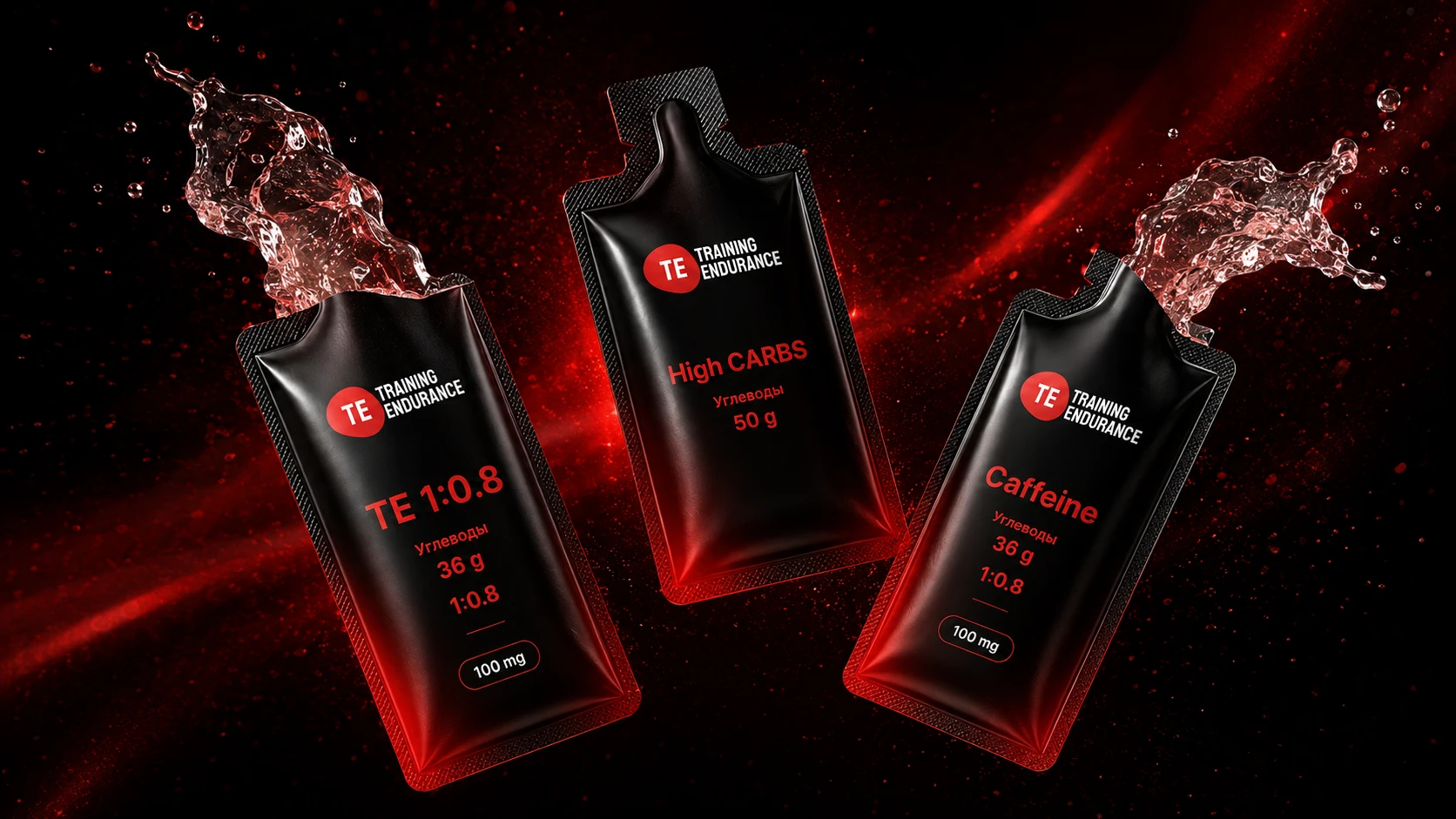
1:0.8, 2:1, High CARBS, PH+, Electrolyte, or Caffeine: the choice depends on the race, water, pace, and GI tract.
A sports gel shouldn’t be a random purchase the day before the start. Every gel should have a job.
One is needed as base energy. A second — when you want a neutral flavor. A third — when you need more carbohydrate in a single stick. A fourth — for heat. A fifth — for the second half of the race. A sixth — for caffeine.
If you understand this logic, fueling becomes not a collection of packages, but a plan.
If you’re just starting to fuel systematically
Start simple.
Your goal isn’t 120 g/h. Your goal is to learn to eat regularly and without problems.
A good start:
TE 1:0.8
36 g of carbohydrate, the modern maltodextrin/fructose ratio of 1:0.8, 100 mg of sodium.
How to use:
- 1 gel every 35–40 minutes;
- then 1 gel every 30 minutes;
- drink water after every gel;
- test on long workouts.
This is the base gel for a marathon, trail, cycling, and long workouts.
If you need the classic scheme
Choose TE 2:1.
It has 40 g of carbohydrate and a 2:1 ratio. This is a clear formula for the 60–90 g/h range.
Who it suits:
- marathoners;
- cyclists;
- triathletes;
- those who don’t want too sweet a flavor;
- those who prefer a neutral formula;
- those who dose electrolytes separately.
Example: 2 TE 2:1 gels per hour = 80 g of carbohydrate per hour.
That’s already a strong working scheme for many races.
If you need more energy in a single stick
Choose TE High CARBS.
It has 50 g of carbohydrate. This isn’t a "just in case" gel. It’s a product for well-trained athletes who already know how to eat during exercise and want to cover more carbohydrate with fewer packages.
Who it suits:
- cyclists;
- triathletes;
- ultra;
- long trails;
- 3–5 hour workouts;
- those who already tolerate 80–100 g/h.
Example: 2 High CARBS gels per hour = 100 g of carbohydrate per hour.
The main rule: High CARBS must be washed down with water and tested in advance.
If the race is long and sweet gets old
Choose TE PH+.
On a long distance the problem often isn’t only energy. It’s the flavor, the acidity, the repetition of the same thing, the feeling in the mouth and stomach.
PH+ is needed where fueling repeats hour after hour. Especially:
- in ultra;
- in heat;
- in the mountains;
- in the second half of the race;
- when acidic flavors start to irritate;
- when you want a gentler formula.
PH+ comes in 1:0.8 and 1:1 versions. This lets you tune not only the flavor but also the carbohydrate logic.
If it’s hot, mountains, and lots of sweat
Choose TE Electrolyte.
It has 36 g of carbohydrate and electrolytes: sodium, potassium, magnesium, calcium, chlorides. This is a gel for situations where carbohydrates alone aren’t enough.
Who it suits:
- trail runners;
- marathoners in the heat;
- cyclists in summer;
- triathletes;
- those who sweat heavily;
- those who get salt streaks on their clothing;
- those who want a simpler way to combine carbohydrates and minerals.
In the heat, fueling should cover not only energy but also water-salt balance.
If you need caffeine
Choose TE Caffeine.
This is a gel for a key segment, not for every intake. Inside: 36 g of carbohydrate, 100 mg of caffeine, and 100 mg of sodium.
Logical moments:
- the second half of a marathon;
- a night segment of an ultra;
- before a long climb;
- before the final segment;
- when you need focus.
Caffeine needs to be tested in advance. For some athletes it works great. For others it can irritate the stomach, increase anxiety, or interfere with drinking.
Gel, drink, or chew: which is better
For the body, what matters isn’t only the product form, but the total amount of carbohydrate, its composition, solution concentration, water, and tolerance. The study by Hearris and colleagues compared intakes of 120 g/h of carbohydrate in different formats: liquid, gel, chew, and a combination of formats. The authors showed that at the same carbohydrate target, different formats can produce comparable oxidation of exogenous carbohydrates during exercise. (journals.physiology.org)
Practical takeaway: you don’t necessarily have to get all your carbohydrates from a single source. For a long race, a system is often more convenient:
gels — a precise carbohydrate portion;
drink — part of the carbohydrates and fluid;
electrolytes — sodium and minerals;
caffeine — targeted;
regular food — as the situation calls for in an ultra.
How to assemble a scheme for your race
Marathon
Base:
- TE 1:0.8 or TE 2:1;
- Caffeine in the second half;
- water at the aid stations;
- PH+ if sweet gets old quickly.
Goal: 60–90 g/h for most well-trained runners.
Trail 3–6 hours
Base:
- TE 1:0.8;
- PH+;
- Electrolyte;
- electrolyte capsules for heat and sweat;
- some fueling can be taken from the aid stations.
Goal: 60–90 g/h, for well-trained athletes 90–110 g/h.
Ultra
Base:
- alternating TE 1:0.8, PH+, Electrolyte;
- High CARBS for segments where you need to cover a lot of energy;
- Caffeine at night or in the second half;
- electrolytes separately;
- be sure to test the flavors.
Goal: not a maximum number, but steadiness.
Cycling
Base:
- TE High CARBS;
- TE 2:1;
- a carbohydrate drink;
- electrolytes;
- Caffeine for key segments.
Goal: 80–100 g/h, for well-trained athletes 100–120 g/h.
Triathlon
Base:
- on the bike you can eat more;
- on the run usually less;
- High CARBS and a drink for the cycling leg;
- PH+ and Caffeine for the run;
- electrolytes for the heat.
The main mistake in triathlon is under-eating on the bike and then trying to save the run.
Conclusion
There is no single best gel.
There’s a gel for the task.
1:0.8 — modern base energy.
2:1 — the classic scheme.
High CARBS — high carbohydrate delivery.
PH+ — a long race and gentleness of perception.
Electrolyte — heat, sweat, mountains.
Caffeine — focus and a key segment.
Fueling should be as precise as a pace plan. Then the gel works not as a rescue, but as part of the race.
the whole TE Gel line Test this logic in the TE selector: gels, water, sodium, and tolerance are calculated as one plan.
Carbohydrate loading: why the race doesn’t begin with the first gel

The race doesn’t begin with the first gel: loading determines what tank the athlete brings to the start.
Many athletes think about fueling only on race day: how many gels to take, where the aid stations will be, when to take caffeine.
But the race begins earlier. It begins with what glycogen store you bring to the start.
A gel during the race shouldn’t rescue an empty body. It should support the work of a system that’s already ready for the load.
What glycogen is
Glycogen is the stored form of carbohydrate in the muscles and liver.
Muscle glycogen is used by the working muscles. Liver glycogen helps maintain blood glucose levels. Both stores are limited. That’s why in a long race it’s important not only to eat along the way but also to start with normal stores.
If you head into a marathon, trail, bike race, or triathlon after several days of under-eating carbohydrates, you’re already losing part of the race before the start.
Loading isn’t "stuffing yourself with pasta"
Carbohydrate loading isn’t one huge dinner before the start. It’s a planned increase in carbohydrates in the diet before a prolonged event.
The position paper on carbohydrates in sports nutrition notes that one common method of carbohydrate loading is increasing carbohydrates to 10–12 g/kg of body weight per day for 36–48 hours before competition. This can further increase muscle glycogen concentration and sustain carbohydrate oxidation during exercise for longer. (Ernährungs Umschau)
But this doesn’t mean everyone needs to eat 12 g/kg. For some athletes that’s too much for the GI tract. Like gels, loading has to be trained in advance.
When loading is needed
Carbohydrate loading makes sense if the race lasts a long time and requires a high pace:
- marathon;
- trail 3+ hours;
- ultra;
- bike race;
- triathlon;
- ski marathon;
- multi-day start;
- a long race in the mountains.
If the load is short and easy, special loading may not be needed.
What a practical scheme looks like
2–3 days before the race:
- reduce training volume;
- raise the proportion of carbohydrates;
- don’t experiment with new food;
- don’t overload on fiber;
- don’t stage a "feast for the belly";
- drink enough fluid;
- keep your usual salt regimen, if there are no medical restrictions.
The day before the start:
- simple food;
- familiar products;
- carbohydrates at every meal;
- without excess fat and heavy dishes;
- don’t test new supplements.
The morning before the start:
- a breakfast that’s already been tested;
- carbohydrates;
- a little fluid;
- without excess fiber;
- without experiments.
Why loading doesn’t replace gels
Even if you loaded well, glycogen isn’t infinite. In a long race its expenditure continues. The higher the intensity, the faster it goes.
That’s why loading and gels aren’t competitors. They’re two parts of one system.
loading — start with a full tank;
gels — top off the fuel along the way;
water and electrolytes — help the system work;
gut training — make it tolerable.
Typical mistakes
Mistake 1. Loading only the evening before the race
One dinner doesn’t solve the task. Moreover, it can overload the GI tract.
Mistake 2. Too much fiber
Vegetables, legumes, and whole grains are healthy in everyday life, but before a race an excess of them can cause bloating and heaviness.
Mistake 3. New products
Before the start you shouldn’t try out new cereals, bars, powders, sauces, and supplements.
Mistake 4. Not enough salt and fluid
Glycogen is stored together with water. If you load carbohydrates but drink poorly, the system works worse.
Mistake 5. Not training the loading
Carbohydrate loading is a skill just like taking gels. It should be tested before a control workout, not before the main start.
How to connect loading with Training Endurance gels
Before the race you build a store. During the race you maintain the flow.
Example for a marathon:
- 36–48 hours before — raise carbohydrates in the diet;
- in the morning — a tested breakfast;
- 10–15 minutes before the start — if needed, a gel or a few sips of a carbohydrate drink;
- the first 20–30 minutes of the race — the first gel;
- after that — a gel every 20–30 minutes according to plan.
For most people this can be a scheme based on TE 1:0.8 or TE 2:1. For well-trained athletes — adding High CARBS, PH+, Electrolyte, or Caffeine as the situation calls for.
Conclusion
Race fueling doesn’t begin with the first gel. It begins with preparing your stores.
Carbohydrate loading helps you start with a full tank. Gels help you not empty it too quickly. And a trained GI tract lets you execute the plan without surprises.
The race is won not by whoever ate more the evening before. It’s won by whoever built the system in advance.
TE gels + regular food Within the TE line you can separate energy and electrolytes: choose the gel’s carbohydrate profile and add Regular or PH+ depending on conditions.
Do you need to train without carbohydrates: the truth about fat metabolism

Training without carbohydrates can be a tool, but it shouldn’t break the quality of key sessions.
In endurance sport an idea has lived for many years: to use fat better, you need to train more often without carbohydrates. There’s some truth in this, but there’s also a big trap.
Yes, the body can adapt to working with low carbohydrate availability. Yes, fat metabolism matters. But this doesn’t mean key workouts should be done hungry and gels used only in the race.
The body doesn’t switch from carbohydrates to fat
Fat and carbohydrates work together. Their contribution changes depending on intensity, duration, fitness, and fuel availability.
At low and moderate intensity the proportion of fat is higher. At high intensity the carbohydrate contribution grows. MySportScience examines the "switching to fat" myth in detail: as intensity rises, fat oxidation may decline while reliance on carbohydrates grows. (askerjeukendrup)
So the question isn’t which is better — fat or carbohydrates. The question is what the workout’s task is.
When you can train without gels
A short easy run, a recovery workout, calm aerobic volume — these can often be done without gels.
That’s fine.
You don’t need to open a gel on every 40-minute jog. Fueling should match the task.
When carbohydrates are needed
Carbohydrates are needed if the workout requires quality:
- a long run over 90 minutes;
- marathon pace;
- intervals;
- a 3–5 hour ride;
- a brick in triathlon;
- a trail with elevation gain;
- a workout in the heat;
- a second workout of the day;
- the last big session before the start.
If you constantly under-eat in such a workout, you can complete the volume, but the quality will be lower, and recovery — longer.
The problem with constant "train low"
Sometimes workouts with low carbohydrate availability can be part of periodization. But if this turns into constant underfueling, the whole system suffers:
- the quality of intense sessions drops;
- recovery is worse;
- the risk of fueling breakdowns is higher;
- fatigue is higher;
- sleep is worse;
- immune resilience may decline;
- the risk of low energy availability grows.
Reviews of carbohydrate availability note that high carbohydrate availability is beneficial in competitions and workouts where you need to maintain a high level of intensity. (PMC)
Why strong athletes eat in training
They’re not afraid of "breaking fat metabolism." They understand that different workouts require different fuel.
An easy day — one strategy.
A key session — another.
A race — a third.
If the workout’s task is quality, pace, power, a long climb, or specific work, carbohydrates help do it better.
If the task is adaptation to low stores, you can use carbohydrate restriction. But it should be deliberate, dosed, and not interfere with the main workouts.
How to combine both approaches
Simple logic:
easy short workouts — can be done without a gel;
long and intense workouts — carbohydrates are needed;
key sessions — fueling by race logic;
before the start — no experiments with hunger;
in the race — maximum carbohydrate availability within your tolerance.
How to use Training Endurance
For workouts where fueling is needed, you can choose a product for the task:
TE 1:0.8 — base energy.
TE 2:1 — the classic for 60–90 g/h.
TE High CARBS — when you need high carbohydrate delivery.
TE PH+ — long sessions where flavor gentleness matters.
TE Electrolyte — heat, sweat, mountains.
TE Caffeine — targeted for hard segments.
You don’t have to eat the maximum on every workout. But it’s important to regularly train the protocol you want to use in the race.
Conclusion
Training without carbohydrates can have its place. But it shouldn’t become an ideology.
Fat metabolism matters. But at high intensity and in a long race, carbohydrates remain a critical fuel.
A savvy athlete doesn’t always eat more. They eat for the task.
TE planning Use this article as a checklist for training: test the flavor, water, carbohydrate dose, and GI response before the start.
Carbohydrates after a workout: why recovery starts right away

After hard work, carbohydrates start recovery right away, especially if a new workout lies ahead.
Fueling during a workout helps you not collapse in pace. Fueling after a workout helps you return to the next session.
If there’s a lot of time between workouts, regular food is often enough. But if the workouts come close together, if it’s a camp, a hard block, two sessions a day, or a multi-day race — carbohydrate recovery becomes critical.
What needs to be restored
After a hard load the body needs to restore:
- muscle glycogen;
- liver glycogen;
- fluid;
- sodium and other electrolytes;
- damaged muscle structures;
- the nervous system;
- overall energy balance.
Carbohydrates don’t cover every task, but they cover one of the main ones — returning glycogen stores.
When recovery is especially important
Carbohydrates after a workout are especially important if:
- tomorrow there’s hard work again;
- today there was a long session;
- there was a workout in the heat;
- there was high intensity;
- there were two workouts in a day;
- a training camp is underway;
- it’s a multi-day start;
- there’s a goal to quickly return to quality.
The position paper on carbohydrates in sports nutrition notes that with a short interval between sessions, in the first 2–4 hours after exercise it can be beneficial to take 1–1.2 g of carbohydrate per kg of body weight per hour for rapid glycogen recovery. If there’s more time between loads, a total daily intake of 6–10 g/kg may be enough to restore stores. (German Journal of Sports Medicine)
Why fueling during a workout helps recovery
If you completely "dig a hole" in a workout, recovery will be longer. If during long or intense work you regularly provided carbohydrates, the depth of that hole is smaller.
This doesn’t mean the workout became easy. It means the body got fuel to complete the task.
Studies on mountain marathoners showed that high carbohydrate intake during exercise can be associated not only with lower internal load but also with better recovery markers after a hard event. (PubMed)
A practical scheme after a hard workout
In the first 30–60 minutes:
- carbohydrates;
- fluid;
- sodium, if there was a lot of sweat;
- protein, if this is full recovery;
- simple food the stomach accepts.
Within 2–4 hours:
- a normal meal;
- carbohydrates in sufficient amount;
- protein;
- salt as needed;
- water without excessive flooding.
Throughout the day:
- make up the total food volume;
- don’t stay in an energy deficit;
- watch urine, thirst, body weight, appetite, and sleep quality.
How to use Training Endurance products
During a hard workout:
- TE 1:0.8 or TE 2:1 for base carbohydrates;
- High CARBS for long sessions with high expenditure;
- Electrolyte or capsules, if it’s hot and there’s a lot of sweat;
- Caffeine only if it’s needed for the task.
After a workout:
- regular food remains the foundation;
- carbohydrates from food or drinks;
- electrolytes with large sweat losses;
- water in small portions.
Gels don’t replace normal food after a workout. But they help you not collapse in energy during the work — and thus, start recovery better.
Conclusion
Recovery starts not when you sit down to dinner. It starts during the workout itself.
If you regularly under-eat on key sessions, you don’t automatically get stronger. Sometimes you simply make recovery harder.
Carbohydrates during exercise help you complete the work. Carbohydrates after help you be ready for the next one.
TE after the load Test this logic in the TE selector: gels, water, sodium, and tolerance are calculated as one plan.
Short efforts and carbohydrate rinse: when a gel isn’t mandatory

Sometimes a gel isn’t mandatory: on short efforts even a carbohydrate rinse can work.
Not every workout requires a gel. If the effort is short, carbohydrates can work differently.
For a long race you need real carbohydrate intake: gels, drink, food. But for efforts of around 30–75 minutes, a different strategy is sometimes used — a carbohydrate mouth rinse.
What a carbohydrate mouth rinse is
A carbohydrate mouth rinse is when an athlete doesn’t swallow a carbohydrate drink but rinses the mouth and spits it out or swallows minimally. The point isn’t to deliver energy to the muscles. The point is the signals from receptors in the oral cavity.
A 2022 systematic review and meta-analysis showed that rinsing with a maltodextrin solution can improve exercise performance, though the effect depends on the protocol and conditions. (Springer)
Why it might work
The body perceives carbohydrates not only as calories. Signals from the oral cavity can affect the central nervous system, the perception of effort, and the readiness to keep working.
This doesn’t replace fueling in a marathon or ultra. But it shows an important thing: carbohydrates work not only through glycogen and blood glucose. They’re also linked to the perception of load.
When it might be useful
A carbohydrate rinse might make sense:
- in short intense workouts;
- when the stomach isn’t ready to take a gel;
- if the workout is 30–60 minutes;
- if it’s important not to overload the GI tract;
- in the heat, when you don’t want a sweet gel;
- in workouts where full fueling isn’t needed.
When a rinse isn’t appropriate
If the effort is long, a rinse won’t replace carbohydrates.
For a marathon, trail, ultra, a 3–5 hour ride, or a triathlon, you need real grams of carbohydrate per hour. There, gels, drinks, bars, food, and electrolytes come into play.
How to build this into your system
For short work:
- you can go without a gel;
- you can use a small amount of carbohydrate;
- you can test a mouth rinse;
- the main focus is on the quality of the workout.
For long work:
- count carbohydrates per hour;
- use different sources;
- drink water;
- account for sodium;
- train the GI tract.
Conclusion
A gel isn’t needed on every short workout. But that doesn’t mean carbohydrates aren’t important.
On short intense work, carbohydrates can help through central mechanisms and the perception of effort. In a long race they’re needed as a full-fledged fuel.
The main thing isn’t a universal scheme, but a match to the task.
FAQ block for the site
How many carbohydrates do you need in a workout?
If the workout is shorter than an hour and not very intense — you can often go without carbohydrates. If the load lasts 60–90 minutes and up, especially at high intensity, carbohydrates already become useful. For long races most athletes use 40–90 g/h, well-trained athletes — 90–120 g/h, and the elite in certain disciplines and conditions test 150–180+ g/h. (Triathlete)
Why can’t you just eat one regular gel per hour?
One gel per hour often provides 20–40 g of carbohydrate. For an easy workout that may be enough. For a marathon, trail, cycling, or triathlon at high intensity it’s often too little. If you’re burning a lot of glycogen, you need to plan carbohydrates per hour, not "a gel now and then."
What’s better: 2:1 or 1:0.8?
2:1 is the classic scheme for 60–90 g/h. 1:0.8 fits better into modern high-carb logic around 100–120 g/h, because it increases the contribution of the fructose pathway. But tolerance is individual, so the best option is the one you’ve tested. (askerjeukendrup)
Can you eat 120 g/h while running?
You can, but not everyone and not right away. On the bike it’s usually easier, because there’s less impact stress on the GI tract. In running, 90–120 g/h requires gut training, water, the right products, and testing at intensity.
Is it true that athletes eat 180 g/h?
Yes, such examples already exist in elite practice, especially in triathlon and cycling. Strategies of about 177–180 g/h are mentioned for Kristian Blummenfelt and Kasper Stornes, as well as about 200 g/h for Cameron Wurf on the cycling leg of an Ironman. But this is the level of well-trained athletes with testing and gut training, not a recommendation for everyone. (Triathlete)
Do you need to eat carbohydrates in training?
Yes, if you want to use carbohydrates in the race. The GI tract needs to be trained. Strong athletes eat in training not because they can’t tough it out, but because they train the race fueling system, maintain the quality of work, and improve recovery.
Can you train without carbohydrates?
Sometimes — yes, if it’s part of deliberate periodization. But key workouts, long sessions, races, and intensity sessions more often require carbohydrates. Modern nutrition periodization doesn’t come down to one method: sometimes you can train with low carbohydrate availability, but for quality, intensity, and race specificity you need fueling training.
Why do gels sometimes make you feel bad?
Common causes:
- too much carbohydrate at once;
- too little water;
- didn’t train the GI tract;
- high intensity;
- heat;
- an unsuitable carbohydrate ratio;
- too much caffeine;
- a flavor that’s too sweet or too acidic;
- started eating late and tried to "catch up" on the dose.
What to do if I want to reach 90 g/h?
Start from your current tolerated dose and increase gradually: 50 → 60 → 70 → 80 → 90 g/h. Use dual-carb gels, drink water, keep a journal, and test on race-like workouts.
What to do if I want 120 g/h?
First steadily tolerate 90 g/h. Then add 10–15 g/h on one long workout per week. Use 1:0.8 or a combination of gels and drink. Check water, sodium, and flavor. If nausea, bloating, or diarrhea appear — roll back.
A short commercial block for the landing page
Eat not more. Eat more precisely.
Modern endurance isn’t only heart rate, pace, and kilometers. It’s the fueling that lets those kilometers happen.
Carbohydrates support power.
Sodium and water help the system work.
A trained GI tract lets you absorb more.
The right carbohydrate ratio opens different transport pathways.
Training Endurance is a system for those who want to build fueling not on guesswork, but on numbers:
- how many carbohydrates per hour;
- what ratio;
- how much sodium;
- how much water;
- when caffeine;
- when PH+;
- when High CARBS;
- when Electrolyte.
First learn to steadily eat 60 g/h.
Then 80.
Then 90.
Then 100–120.
And leave 150–180 g/h for those cases when the GI tract, training, and race are truly ready.
A gel isn’t a rescue in a moment of crisis. A gel is part of a plan that keeps the crisis from starting.
TE gel by task Within the TE line you can separate energy and electrolytes: choose the gel’s carbohydrate profile and add Regular or PH+ depending on conditions.