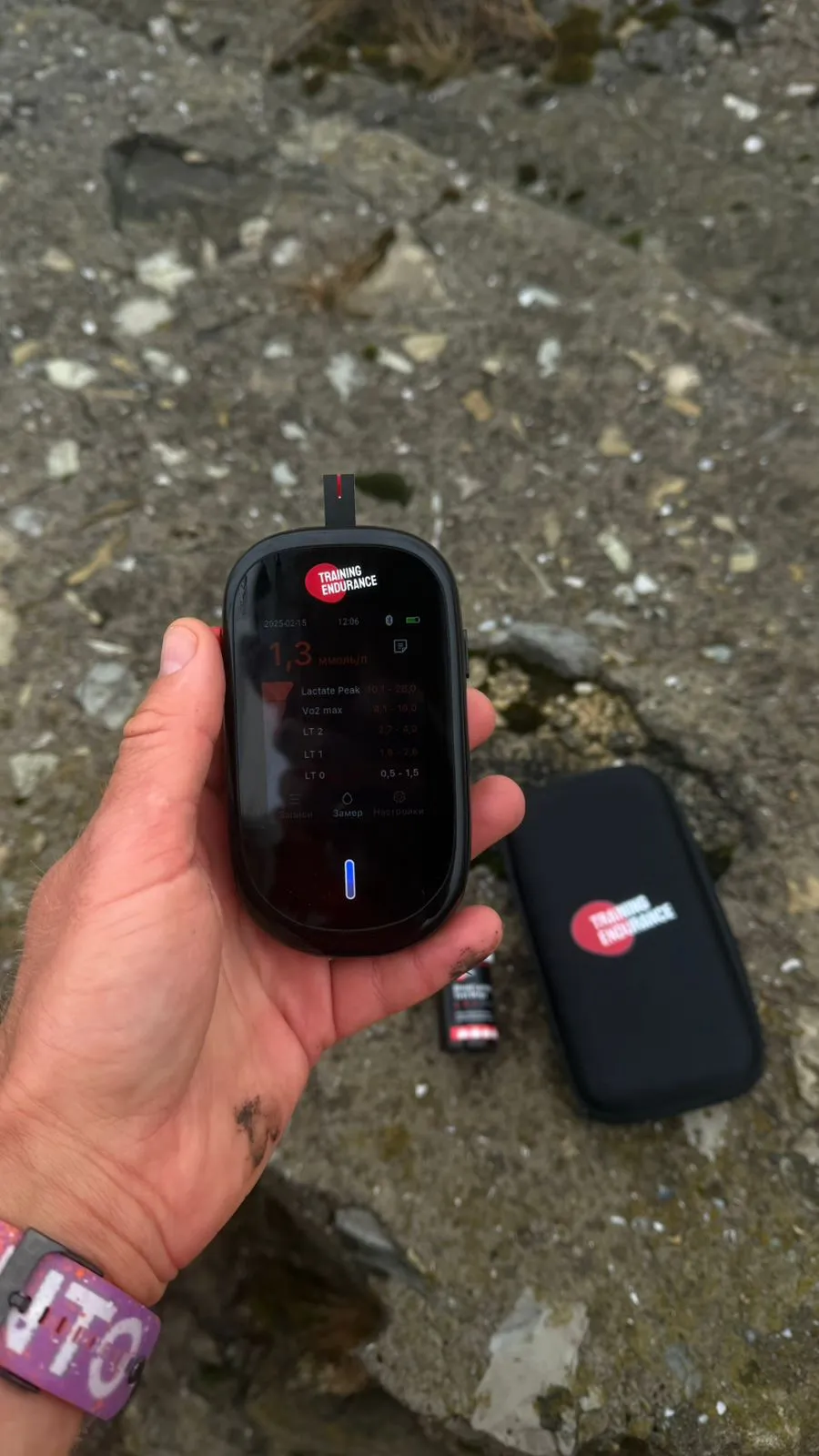
Lactate and Load
To fully understand what lactate is, we need to look at our energy systems. Energy systems need fuel to…

To fully understand what lactate is, we need to look at our energy systems. Energy systems need fuel to produce energy. One such fuel is carbohydrate. The energy system uses glucose (carbohydrate) to produce energy. The end product of this process is lactate! In other words: lactate is the end product of glycolysis.
The higher your lactate, the more carbohydrate you are using. It is impossible to measure the exact amount of fat and carbohydrate with a lactate analyzer, but lactate does a good job of reflecting the "more or less" trend — the higher it is, the greater the carbohydrate expenditure.
Lactate production and clearance
Lactate is produced by the body all the time, even at rest, because at any given moment both aerobic and anaerobic energy production are in use (mitochondrial respiration, the glycolytic system, or creatine phosphate).
Lactate is a byproduct of glucose use by muscle cells. The higher the flux of glucose into the cell, the higher the lactate production — regardless of oxygen availability. During high-intensity exercise, type II-a muscle fibers are fully recruited because of the high contractile demands placed on skeletal muscle to produce energy (ATP). Type II muscle fibers are highly glycolytic (they consume a lot of glucose), which leads to the formation of large amounts of lactate. This production is a natural byproduct of glucose utilization by skeletal muscle cells. During intense exercise, lactate production is many times higher than at rest.
As more and more ATP (adenosine triphosphate — the body’s energy currency) is required to meet the demands of increasing workload, the contribution of the glycolytic anaerobic system also increases. The end product of the glycolytic anaerobic system is pyruvate, which is either oxidized in the mitochondria or converted into lactate. Thus, a reduction in lactate production occurs because of the greater capacity of the aerobic system (mitochondrial respiration) to oxidize fat and supply the bulk of the energy demand, reducing the contribution of and demand for anaerobic energy production at a given power output.
The mechanism of lactate clearance
Clearing the lactate that is produced (and, importantly, the associated metabolites linked to the onset of fatigue) involves transporting lactate out of the contracting muscle fibers to other locations, where it is either oxidized in the mitochondria or used in a process called gluconeogenesis — essentially the reverse conversion of lactate back into glucose/glycogen.
Lactate can be exported into the blood for clearance and used for energy in virtually every organ of the body. However, this process takes time (minutes), whereas lactate is produced continuously during exercise.
The higher your fitness level, the more efficient the muscles are and the less lactate reaches the blood, because they clear large amounts of it right in the muscle, which takes seconds or milliseconds. This is very advantageous, because it allows the contracting muscles to remove H⁺ faster, and it also enables faster "recycling" of lactate to obtain additional energy (ATP).
During exercise, lactate is mainly produced in fast muscle fibers, which use a lot of glucose for energy. It is cleared mainly by slow muscle fibers. This is a complex process involving various lactate-specific transporters and enzymes.
Adaptations that improve lactate clearance
Some adaptations that lead to improved lactate transport include training volume, training in the steady-state lactate zone, at threshold, and slightly above it. The key is to dose the load correctly. Another key factor affecting the ability to clear lactate is VO2max, since it influences the rate of lactate oxidation. Lactate oxidation contributes most to lactate clearance during moderate- to high-intensity exercise.
Lactate and fatigue
One of the biggest misconceptions is that lactate is our enemy and causes fatigue, but that is not the case at all. As exercise intensity increases, athletes start using more carbohydrate as fuel. As a result, more lactate is produced. This is one of the reasons people have grown accustomed to thinking that lactate is a byproduct that causes fatigue: at high exercise intensity the lactate concentration is high, and athletes get tired. However, there is no cause-and-effect relationship between lactate and fatigue.
Lactate does NOT cause fatigue; it is not even "waste." It is FUEL!
The anaerobic energy system produces lactate. The aerobic energy system uses this lactate as fuel to produce even more energy.
Diagram of the energy systems: carbohydrates and fats
The release of hydrogen ions (H⁺) associated with lactate can lead to a significant drop in the pH of the contracting muscle, resulting in acidosis. This excessive accumulation of H⁺ — not only from lactate, but also from the breakdown of ATP during muscle contraction (ATP hydrolysis) — can interfere with muscle contraction in several ways. For example, H⁺ can compete with calcium (Ca²⁺) to bind to a protein involved in regulating muscle contraction. H⁺ can also inhibit the release and reuptake of calcium from the sarcoplasmic reticulum. Both processes are involved in muscle contraction. All of this can lead to a reduced ability of the muscle to contract, which means a significant reduction in strength and performance.
Lactate itself is not harmful to the body, but producing a lot of it leads to a drop in pH — and this acidic environment has a negative effect on performance.
Lactate thresholds
There are 2 lactate thresholds.
LT1 is the lowest exercise intensity at which a measurable increase in blood lactate concentration is observed compared with the resting lactate concentration. LT1 is the first lactate threshold and should not be confused with LT2 (lactate threshold 2, or the anaerobic threshold).
In the context of endurance training, LT1 is marked as the first rise in lactate concentration above resting lactate concentrations. Lactate threshold 1 is typically, on average, 1–2 mmol/L.
We only need LT1 as an indirect marker of fat and carbohydrate expenditure, because when you run faster or slower than the first threshold, nothing dramatic changes. When you train just above LT1, lactate concentrations will remain in a steady state. LT2, on the other hand, is a "threshold" because it clearly distinguishes two intensities from one another:
Above LT2 — lactate concentrations will rise over time. There is no longer a lactate steady state.
Below LT2 — lactate concentrations will not increase over time. A lactate steady state exists.
With LT1 there is no such clearly visible difference below and above the threshold.
LT2 is the highest intensity at which lactate in the muscle and blood can reach a constant concentration, which is why it is usually called the maximal lactate steady state. In other words, it is the point at which the rate of lactate production exactly equals the rate of clearance, where any decrease in intensity will cause lactate levels to fall, and an increase in intensity will lead to a nonlinear accumulation of lactate. The term "lactate threshold" is interchangeable with the terms anaerobic threshold, LT2, or VT2. However, all these terms have slightly different meanings due to the different measurement methods. Lactate threshold 2 is typically, on average, 4 mmol/L. On average, you will be able to sustain such an intensity for about 40–130 minutes depending on the amount of energy available as carbohydrate.
Training zones
If we look at the classic 3-zone model, it can be broken down roughly as follows:
Training zone 1: below LT1 (1–2 mmol/L)
Training zone 2: between LT1 and LT2 (2–4.5 mmol/L)
Training zone 3: above LT2 (above 4.5 mmol/L)