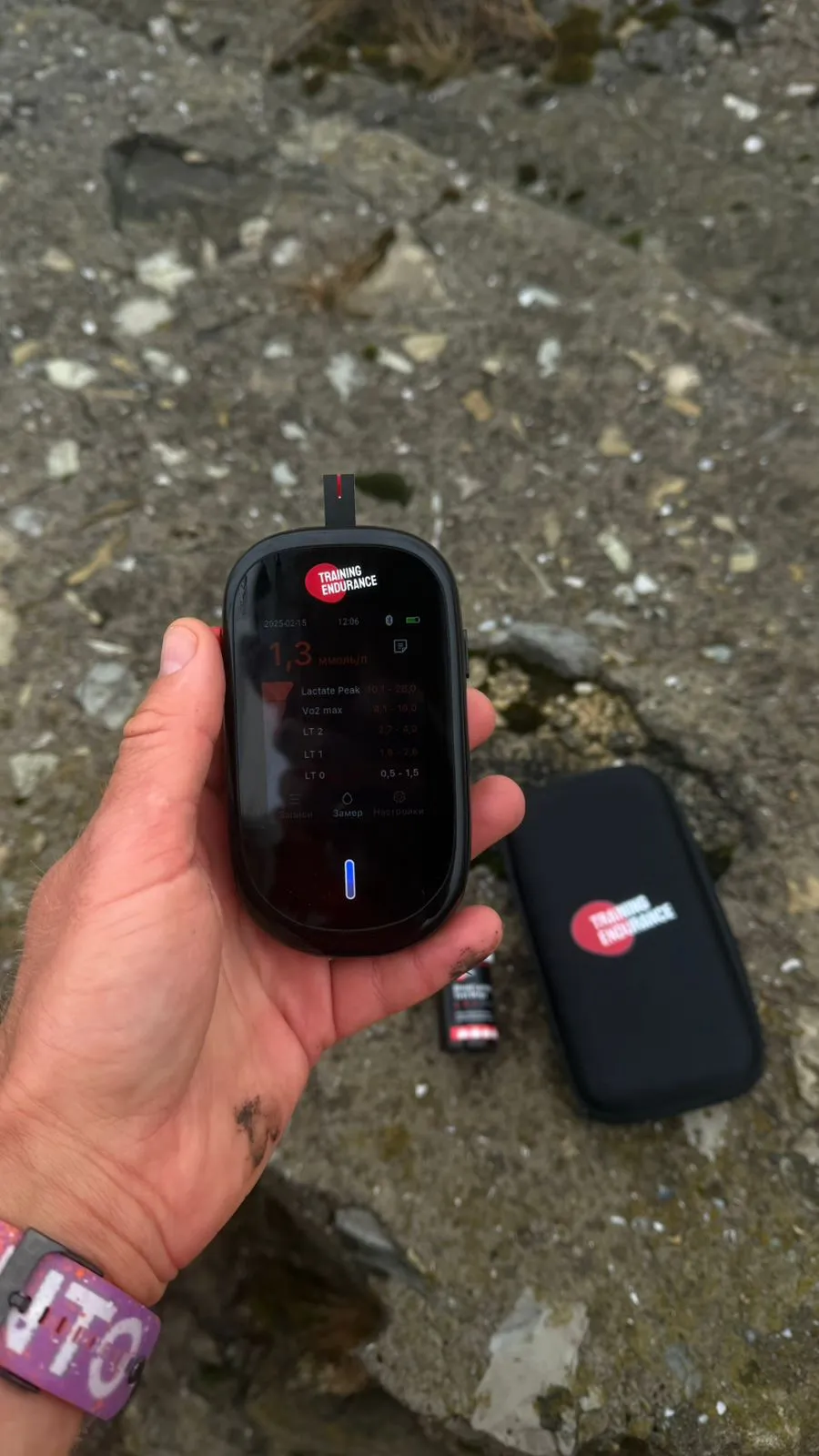
Same Intensity, Different Lactate Readings
Why can lactate readings differ at the same intensity? Several key factors are at play. Changes in blood volume When…

Why can lactate readings differ at the same intensity? Several key factors are at play.
Changes in blood volume
When a person trains, various adaptations can cause blood volume to change — it can either increase or decrease. Heat training and altitude training have an especially strong effect. In endurance sports we should aim to increase blood volume, but this doesn’t always happen.
Lactate and other blood markers are measured in the blood, and our measurements are taken per ml or per liter of fluid — we are assessing concentration, not the total amount. That’s exactly why, whenever we run any blood tests, we have to understand that a change in blood volume can also change the data measured per ml/L of blood.
Incidentally, this applies not only to lactate but to other markers as well. Often, for example, when at altitude we might run a blood test for hemoglobin and see a significant increase in the numbers, but that doesn’t mean you’ve achieved a positive change — you still have the same total amount of hemoglobin, it’s just that the blood volume has changed. At altitude, because of the properties of the air, we lose more fluid through breathing and thereby become dehydrated. For the data to be accurate we need to know the blood volume — this can be measured, but it isn’t available in ordinary labs.
The same, by the way, applies to heart rate, which is also not a volume-based marker but a concentration-based one. That’s precisely why we see a significant rise in heart rate when, for example, we are dehydrated.
The unit for blood lactate is mmol/L (millimoles per liter of blood), and blood volume itself can change with adaptation to heat stress and other circumstances. For example, in the off-season it can decrease fairly quickly, which can lead to a higher concentration of the measured lactate.
Let’s look at what happens when plasma volume changes. Example: an athlete records 1 mmol/L on the analyzer with a blood volume of 5 L — the athlete’s blood contains a total of 5 mmol of lactate. If the volume increases to 5.5 L, the concentration drops to 5 mmol / 5.5 L = 0.91 mmol/L, which seems insignificant. If a test produces a blood lactate of 15 mmol/L with a blood volume of 5 L, then total lactate is 75 mmol. If this same test is done with 5.5 L of blood, the resulting value is 75 mmol / 5.5 L = 13.6 mmol/L. And if the volume changes from, say, 5 L to 7 L, the difference will be even more substantial.
Energy availability
At the cellular level, trillions of chemical reactions take place every second to make us move. We can’t control these reactions, and most of them can’t even be measured. But sustaining the processes in these reactions requires a large amount of fuel. With every hard workout we raise the level of stress, and if the body can’t cope with this level, there will be no progress from the training.
To manage this stress, we measure lactate levels. But, as we discussed in one of the previous posts, lactate is a byproduct of carbohydrate oxidation. If we have a carbohydrate deficit, the workout may not be completed, and lactate may be lower than usual in the initial stage, then become higher in subsequent workouts due to mitochondrial dysfunction.
The impact of hard workouts
Any heavy load that leads to severe stress, followed by insufficient recovery, can cause mild to severe mitochondrial dysfunction, which will affect lactate clearance.
Mitochondria are the energy source of your cells. Their job is to convert the nutrients you consume into energy by producing adenosine triphosphate (ATP) — a coenzyme your cells use for a whole range of functions, from respiration to physical exercise. When you increase the size and number of your mitochondria through mitochondrial biogenesis, the mitochondria can convert energy into ATP more efficiently, which means more energy is available to the working muscles.
Any negative change in the structure of the mitochondria will affect lactate readings, and at the same intensity you’ll see different numbers.
Sampling errors
We’ve covered how to take a sample correctly in previous posts. Let’s remind you once more: when taking a lactate sample, the most important things remain the sterility of the strip and a clean blood sample free of sweat or alcohol from the wipe. Even the slightest trace of alcohol or sweat will affect the result — our sweat also contains lactate, but it is very unstable, and the alcohol content affects the reaction between the strip and the blood.
It’s also very important that the sample comes from a single drop and that the blood opening in the strip is filled in one go — the blood should get only into the opening, not spread across the entire strip.